How to Write a Resume for Remote Jobs: Stand Out in a Competitive Market
How to write a resume that lands remote job interviews. Which skills to highlight, how to showcase remote work experience, and the format that gets past ATS filters for work-from-home positions.
Remote jobs get 50% of all job applications while making up a shrinking percentage of listings.
That means for every remote position you apply to, you’re competing against hundreds of candidates who want the same thing: flexibility, no commute, and the ability to work from anywhere.
Your resume needs to do more than list your experience. It needs to prove you can deliver without someone looking over your shoulder.
Why Remote Resumes Are Different
When a hiring manager reviews applications for an in-office role, they assume you can show up, collaborate face-to-face, and figure things out by walking over to a colleague’s desk.
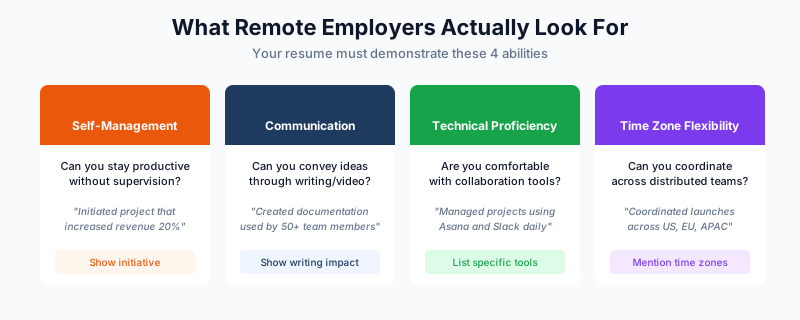
Remote roles require proof of different abilities:
- Self-management: Can you stay productive without supervision?
- Communication: Can you convey complex ideas through writing and video calls?
- Technical proficiency: Are you comfortable with digital collaboration tools?
- Time zone flexibility: Can you coordinate across distributed teams?
Essential Skills to Highlight for Remote Positions
Technical Skills Remote Employers Want
| Skill Category | Specific Tools & Platforms |
|---|---|
| Communication | Slack, Microsoft Teams, Zoom, Google Meet |
| Project Management | Asana, Trello, Monday.com, Jira, Basecamp |
| Documentation | Notion, Confluence, Google Docs |
| Time Tracking | Toggl, Clockify, Harvest |
| File Sharing | Google Drive, Dropbox, OneDrive |
| Video Collaboration | Loom, Miro, Figma |
If you’ve used these tools, say so explicitly. Don’t assume recruiters will infer your technical comfort level.
Quick win: When you tailor your resume with ReviseCV, it automatically identifies which remote collaboration tools the job posting mentions and ensures they appear on your resume.
Soft Skills That Matter More for Remote Work
Self-direction: Show achievements where you initiated projects or solved problems without being told what to do next.
Written communication: When you can’t tap someone on the shoulder, writing is how you get things done. Highlight documentation, reports, or stakeholder communications.
Time management: Juggling multiple priorities, meeting deadlines across time zones, staying productive in unstructured environments.
Adaptability: Learning new tools quickly, implementing new systems, adjusting to changing processes.
How to Showcase Remote Work Experience
If you’ve worked remotely before, make it obvious. Don’t bury this information.
Option 1: Add “Remote” to Your Job Location
Senior Marketing Manager
Acme Corp | Remote | 2022-Present
Option 2: Mention It in Your Bullet Points
“Collaborated with distributed team across 4 time zones to launch product on schedule”
“Managed client relationships entirely through video calls and asynchronous communication”
Option 3: Create a Remote Work Section
If you have extensive remote experience, consider a dedicated section:
REMOTE WORK EXPERIENCE

• 4+ years working fully remote across multiple organizations
• Proficient in async communication using Slack, Notion, and Loom
• Experience coordinating projects across US, EU, and APAC time zones
• Built and maintained client relationships without in-person meetings
What If You Don’t Have Remote Experience?
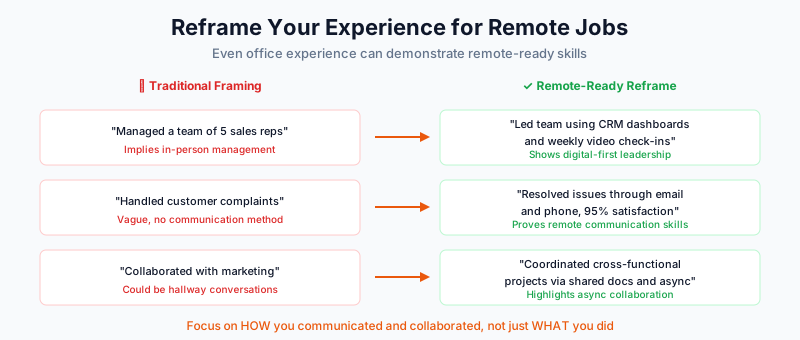
Never worked remotely? Look at your current or past roles and reframe them:
| Traditional Experience | Remote-Ready Reframe |
|---|---|
| “Managed a team of 5 sales reps” | “Led team using CRM dashboards and weekly video check-ins” |
| “Handled customer complaints” | “Resolved customer issues through email and phone, averaging 95% satisfaction” |
| “Collaborated with marketing department” | “Coordinated cross-functional projects using shared documents and asynchronous updates” |
Online courses, open source contributions, side projects, and remote volunteer work all count here too.
Resume Format for Remote Job Applications
Use a Clear, ATS-Friendly Structure
Remote job postings get flooded with applications. Companies rely heavily on ATS to filter candidates. Your resume needs to be machine-readable.
Do:
- Use standard section headers (Experience, Skills, Education)
- Stick to a single-column layout
- Save as PDF with a professional filename (FirstName_LastName_Resume.pdf)
- Use standard fonts like Arial, Calibri, or Georgia
Don’t:
- Use tables, text boxes, or graphics
- Include headers or footers (ATS often ignores them)
- Get creative with section names (“My Journey” instead of “Experience”)
Optimize Your Professional Summary
Your summary should immediately signal remote readiness. Don’t make recruiters hunt for it.
Before (Generic):
“Experienced project manager with 6 years of experience leading cross-functional teams.”
After (Remote-Optimized):
“Project manager with 6+ years leading distributed teams across multiple time zones. Proven track record managing complex projects using Asana and Slack, with 98% on-time delivery rate. Comfortable with asynchronous communication and independent decision-making.”
Create a Targeted Skills Section
Remote job postings include specific tool requirements. Match them.
Example Skills Section for Remote Position:
SKILLS

Remote Collaboration: Slack, Zoom, Microsoft Teams, Loom, Notion
Project Management: Asana, Trello, Monday.com, Jira
Documentation: Confluence, Google Workspace, SharePoint
Technical: [Your industry-specific tools]
Languages: English (Native), Spanish (Professional)
Keywords Remote Employers Search For
Work these terms into your resume where they fit:
| Category | Keywords to Include |
|---|---|
| Work Style | Remote, distributed, virtual, hybrid, work-from-home |
| Communication | Asynchronous, cross-functional, stakeholder management |
| Self-Management | Self-directed, autonomous, independent, proactive |
| Time Management | Deadline-driven, prioritization, time zone coordination |
| Tools | [Specific tools from the job posting] |
Pro Tip: ReviseCV’s Resume Tailor automatically extracts remote-specific keywords from job postings and integrates them into your resume. Paste a remote job description, get a tailored resume in about 2 minutes.
Common Remote Resume Mistakes
Mistake #1: Not Mentioning Remote Experience at All
If you’ve worked remotely, even partially, say so. Recruiters filtering for remote candidates might skip over your resume if it’s not obvious.
Mistake #2: Only Listing Tools Without Context
“Proficient in Slack” means nothing. Instead:
“Used Slack to coordinate daily standups and async updates with 12-person distributed team across 3 time zones”
Mistake #3: Ignoring the Job Description
Remote positions vary widely. A remote customer service role needs different skills than a remote software engineering position. Tailor your resume to each specific posting.
Mistake #4: Forgetting About Time Zones
If you’re applying to companies in different regions, mention your flexibility:
“Available for meetings during US Eastern business hours” “Experience working with teams across US, EU, and APAC time zones”
Key Takeaways
- Prove remote readiness: Don’t just say you want remote work. Show you can succeed at it.
- Highlight relevant tools: List specific collaboration and communication platforms you’ve used.
- Reframe existing experience: Even traditional office experience can show remote-ready skills.
- Tailor and optimize for ATS: Remote jobs get huge applicant volumes. Customize your resume for each posting so it gets through the filter.
- Show, don’t tell: Instead of claiming you’re “self-motivated,” describe achievements that prove it.
Ready to Land Your Remote Role?
Remote jobs are competitive, but a strong resume gets you in the door. Make sure yours shows not just what you’ve done, but how you work well without an office.
Tailor your resume for remote jobs → and get a version optimized for your next application in about 2 minutes. Or check your resume score to see which keywords and skills you’re missing.