The Complete Guide to Canadian Resume Format for Newcomers
Your international experience is valuable. Learn exactly how to format your resume for Canadian employers and start getting the interviews you deserve.
You have years of experience. Strong qualifications. Impressive achievements. But after sending dozens of resumes to Canadian employers, you’re hearing nothing back.
The frustrating truth? Your resume probably looks “wrong” to Canadian hiring managers, even though your experience is exactly what they need.
This isn’t about your qualifications. It’s about format, and the good news is that format is fixable. This guide will show you exactly how to adapt your international resume to Canadian standards so your experience gets the attention it deserves.
Why Canadian Resume Format Matters
Canadian employers have specific expectations about how resumes should look. When your resume doesn’t match these expectations, it stands out for the wrong reasons. Hiring managers may assume you don’t understand Canadian workplace culture, even if you’re perfectly qualified for the role.
This matters because 70% of resumes are filtered by Applicant Tracking Systems (ATS) before a human ever sees them. Format issues can cause these systems to reject qualified candidates. Then, even if your resume passes the ATS, a hiring manager spends just 6 seconds on their first scan. Unfamiliar formatting can make them move on to the next candidate.
The differences between international CVs and Canadian resumes aren’t random. They reflect Canadian workplace values: brevity, privacy, and focusing on results over credentials. Once you understand these differences, adapting your resume becomes straightforward.
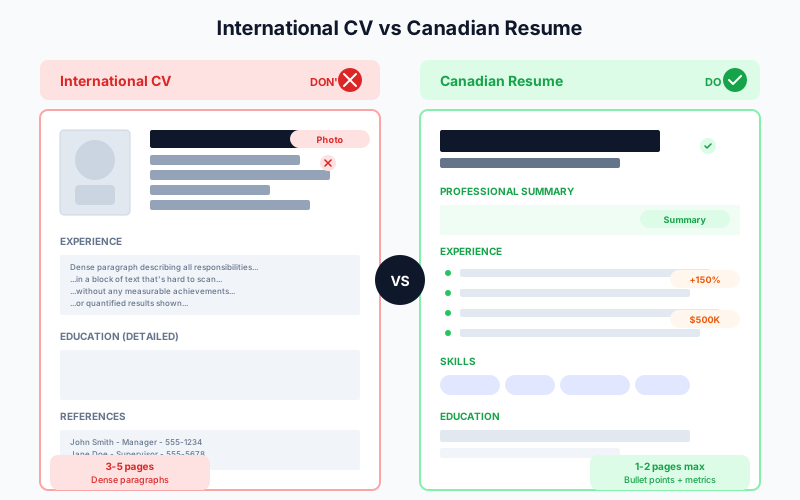
International CV vs Canadian Resume: Key Differences
Here’s what changes when you adapt your resume for the Canadian market:
| Element | International CV | Canadian Resume |
|---|---|---|
| Length | Often 3-5+ pages, comprehensive academic history | 1-2 pages maximum, focus on relevant experience |
| Photo | Common or required in many countries | Never include (can lead to discrimination claims) |
| Personal Details | Date of birth, marital status, nationality, ID numbers | Only name, phone, email, city, LinkedIn |
| Format Name | Called “CV” or “Curriculum Vitae” | Called “Resume” (CV reserved for academic/research roles) |
| Structure | Chronological education and employment history | Reverse chronological, results-focused |
| Education Details | Detailed coursework, thesis titles, supervisor names | Degree, institution, year (unless recent graduate) |
| References | Listed on document with contact information | “Available upon request” or omit entirely |
| Hobbies/Interests | Often included to show well-rounded personality | Omit unless directly relevant to job |
| Language | British English or local conventions | Canadian English (mix of US and UK spelling) |
Start with an ATS-Friendly Template
The fastest way to get Canadian formatting right is to start with a template designed for the Canadian market. These templates handle all the formatting details so you can focus on your content.
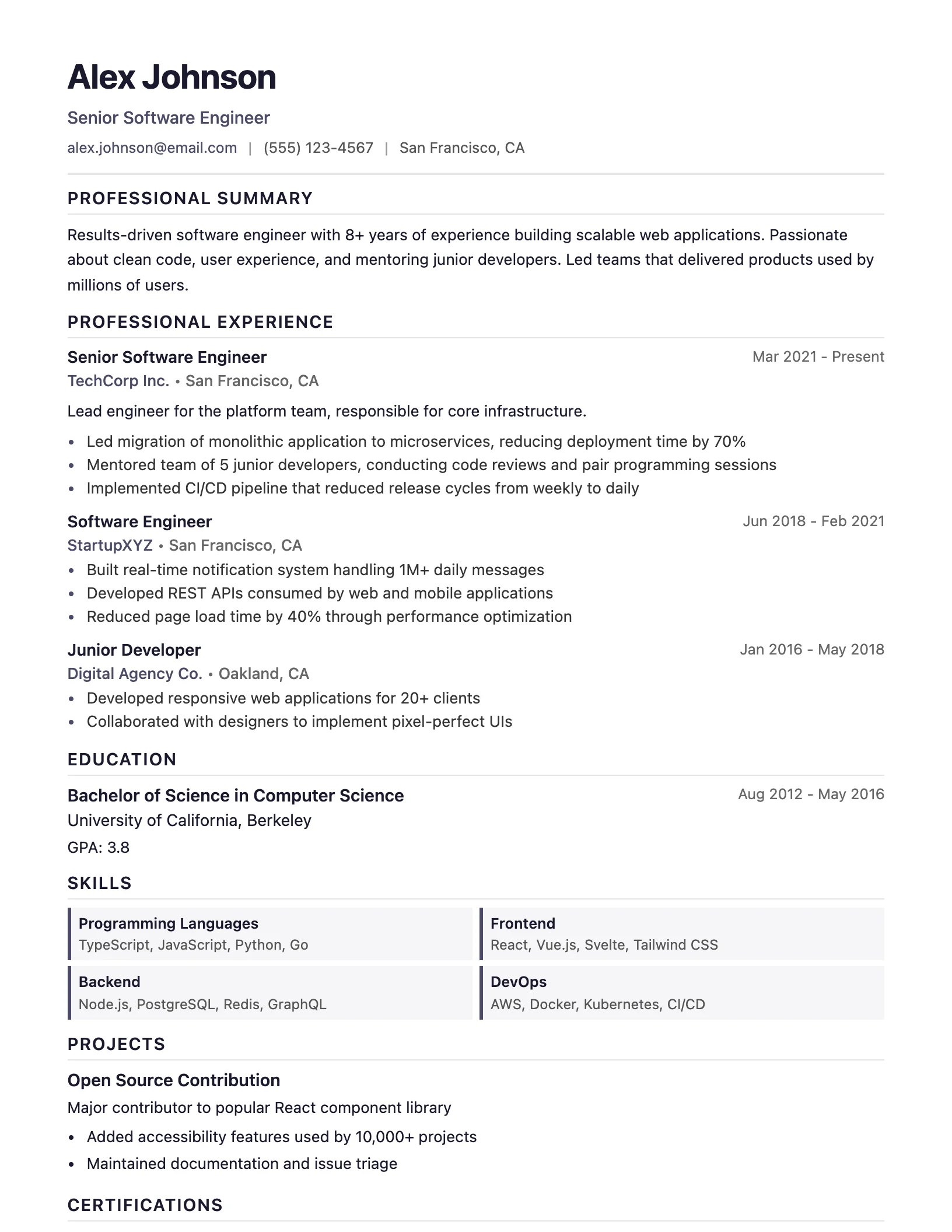 The Corporate Clean template is ideal for traditional industries like finance, government, and healthcare. Browse all 20+ templates →
Your Contact Information: What to Include (and Exclude)
Start your Canadian resume with only the essential contact details. This section should be clean and professional.
Include:
- Full name (first and last)
- Phone number (Canadian format: 416-555-0123)
- Professional email address (firstname.lastname@email.com)
- City and province (Toronto, ON)
- LinkedIn profile URL (if complete and professional)
- Portfolio or personal website (if relevant to your field)
Exclude:
- Photograph or headshot
- Date of birth or age
- Marital status or number of children
- Nationality, citizenship, or immigration status
- Government ID numbers (SIN, passport number)
- Full street address (city and province are sufficient)
- Gender or pronouns (unless you choose to include pronouns for personal reasons)
Canadian privacy and human rights laws prohibit employers from making hiring decisions based on age, marital status, nationality, or other protected characteristics. Including this information can actually work against you because it puts employers in an uncomfortable legal position.
Professional Summary: Your 30-Second Pitch
Canadian resumes typically start with a brief professional summary (2-4 lines) that tells employers exactly what you offer. This isn’t a list of what you want in a job. It’s a snapshot of your value.
Weak example: “Experienced professional seeking challenging opportunities in a dynamic organization where I can utilize my skills and grow my career.”
This says nothing about what you actually do or what makes you valuable.
Strong example: “Senior project manager with 8+ years leading cross-functional teams in software development. Delivered 20+ projects on time and under budget, including a system migration that reduced operational costs by 30%. PMP certified with expertise in Agile and Waterfall methodologies.”
This immediately tells the employer who you are, what you’ve accomplished, and what you bring to the role.
Focus your summary on:
- Your role/title and years of experience
- Industries or specializations
- One or two impressive, quantified achievements
- Key technical skills or certifications relevant to the job
Work Experience: Show Results, Not Just Duties
This is where newcomers often struggle most. Many international CVs list job responsibilities in paragraph form. Canadian resumes focus on achievements and use bullet points for easy scanning.
What Canadian employers want to see:
- What you accomplished, not just what you were responsible for
- Quantified results whenever possible (numbers, percentages, dollar amounts)
- Action verbs that show initiative and impact
- Relevant experience tailored to the job you’re applying for
❌ Before: International CV Style
Marketing Manager, ABC Corporation, Mumbai (2018-2023)
I was responsible for managing the marketing department and overseeing all marketing activities including digital campaigns, content creation, and brand management. My duties included managing a team of five people, creating marketing strategies, coordinating with external agencies, and reporting to senior management. I worked on various campaigns and initiatives to increase brand awareness and customer engagement.
✅ After: Canadian Resume Style
Marketing Manager, ABC Corporation, Mumbai (2018-2023)
- Grew organic website traffic by 150% over 18 months through SEO strategy and content marketing
- Managed $500K annual marketing budget, consistently delivering campaigns 10-15% under budget
- Led team of 5 marketing specialists, implementing weekly training that improved campaign performance by 35%
- Launched digital transformation initiative that increased lead generation by 200% and reduced cost per lead by 40%
- Coordinated rebranding campaign across 6 markets, resulting in 25% increase in brand recognition
Key Differences:
| International CV | Canadian Resume |
|---|---|
| Paragraph format | Bullet points |
| Describes duties | Shows achievements |
| No metrics | Quantified results (%, $, #) |
| Passive voice | Action verbs |
| “Responsible for…” | “Led…”, “Grew…”, “Launched…” |
Formula for strong bullet points: [Action verb] + [what you did] + [quantified result/impact]
Start each bullet with a strong action verb: Led, Managed, Increased, Reduced, Developed, Implemented, Streamlined, Launched, Achieved, Negotiated.
Education: Less Is More
In many countries, education sections are detailed and prominent. In Canada, unless you’re a recent graduate, your work experience matters more than your educational background.
For experienced professionals (5+ years of experience):
Keep your education section brief and place it near the end of your resume. Include only:
- Degree name and major
- Institution name
- Location (city, country if outside Canada)
- Graduation year (or “Expected graduation: [month/year]” if in progress)
Example:
Bachelor of Science in Computer Engineering National Institute of Technology, Delhi, India, 2015
You don’t need to include:
- GPA or grades (unless specifically requested or you’re a recent graduate)
- Coursework details
- Thesis or dissertation titles
- Supervisor names
- High school information (if you have a university degree)
For recent graduates (less than 2 years of experience):
You can include slightly more detail since education is a bigger part of your profile:
- Relevant coursework (if directly related to the job)
- Academic honors or awards
- Significant projects or research
- GPA if above 3.5/4.0 (or equivalent)
Important note about foreign credentials:
If you have a credential that might be unfamiliar to Canadian employers, you can add a brief clarification:
Bachelor of Technology (B.Tech) in Mechanical Engineering (equivalent to Bachelor of Engineering) Indian Institute of Technology, Chennai, India, 2016
If you’ve had your credentials assessed by a Canadian credential evaluation service (like WES), you can mention this:
Master of Business Administration University of Lagos, Nigeria, 2018 (Credential evaluation: Master’s degree equivalency, WES)
Skills: Be Specific and Honest
Canadian employers value specific, verifiable skills over vague claims. Your skills section should be scannable and relevant.
Organize skills into categories:
Technical Skills: Python, Java, SQL, AWS, Docker, Kubernetes, Git, RESTful APIs, Microservices
Languages: English (fluent), French (conversational), Hindi (native)
Certifications: Project Management Professional (PMP), AWS Certified Solutions Architect
Avoid vague soft skills without context: Don’t just list “leadership,” “communication,” or “teamwork.” These are meaningless without proof. Instead, demonstrate these qualities through your achievements in your work experience section.
Language proficiency matters: Be honest about your English proficiency. If you’re fluent in multiple languages, this is valuable. Many Canadian companies serve diverse communities and international markets. Frame additional languages as business assets:
Languages: English (fluent), Mandarin (native), Cantonese (fluent) - served Mandarin-speaking clients across Asia-Pacific region
What to Remove From Your Resume
These elements are common on international CVs but can hurt your chances with Canadian employers:
1. Personal information that invites bias: Remove date of birth, age, marital status, children, nationality, religion, or any photos. Canadian employers legally cannot discriminate based on these factors, and including them puts everyone in an awkward position.
2. References listed on your resume: The phrase “References available upon request” is optional and increasingly outdated. Employers assume you have references and will ask for them when needed. Save that space for relevant achievements.
3. Salary expectations or history: Never include current or past salaries on your resume. This information belongs in the negotiation phase, not on your application.
4. Reasons for leaving previous jobs: Don’t explain why you left each role. This conversation happens during interviews if employers are interested.
5. Irrelevant work experience: If you’ve been working for 10+ years, you don’t need to list every job you’ve ever had. Focus on the last 10-15 years and roles relevant to your target position. Earlier experience can be summarized briefly.
6. Hobbies and personal interests: Unless your hobby is directly relevant to the job (for example, you’re applying for a sports marketing role and you coach youth soccer), leave this off. Use the space for professional achievements instead.
7. Overly formal or flowery language: Canadian workplace culture values directness and clarity. Avoid phrases like “To whom it may concern” or “I humbly submit my application.” Your resume should be confident and professional, not deferential.
The Canadian Experience Question
This is the concern that keeps many newcomers up at night: “All the jobs say they want Canadian experience. I don’t have any. What do I do?”
First, understand what employers really mean by “Canadian experience.” They’re usually concerned about:
- Communication in a Canadian workplace (meetings, emails, presentations)
- Understanding Canadian business culture and expectations
- Having verifiable references in Canada
Here’s how to address this without lying or underselling yourself:
1. Highlight transferable experience: If you managed a team of 10 in India, you can manage a team of 10 in Canada. If you developed software in Nigeria, you can develop software in Toronto. Skills transfer. Focus on accomplishments that speak for themselves.
2. Include any Canadian connections: Have you:
- Completed Canadian certifications or training?
- Volunteered with Canadian organizations?
- Done contract work or freelance projects for Canadian clients?
- Participated in Canadian professional associations?
Include these, even if they’re not full-time jobs.
3. Show cultural fit through your resume format: By following Canadian resume conventions, you’re already demonstrating that you understand Canadian professional norms. This is your first proof that you can adapt to Canadian workplace culture.
4. Network strategically: While your resume is important, many newcomers find their first Canadian role through networking, informational interviews, and referrals. A Canadian-formatted resume makes it easier for your network to forward your credentials to their contacts.
Understanding Canadian Workplace Culture Through Your Resume
Your resume is your first cultural translation. Here’s what Canadian employers value, reflected in how you present yourself:
Brevity and efficiency: Canadians value getting to the point. Your resume should be concise, scannable, and focused. This is why two pages maximum is the standard, even for senior professionals.
Results over titles: What you accomplished matters more than your job title or where you went to school. This is why Canadian resumes emphasize quantified achievements.
Privacy and equality: Canadian human rights legislation reflects values of equal opportunity. Resumes omit personal information that could lead to bias. This protects both you and the employer.
Directness and humility: Canadian communication style is generally direct but not aggressive. Your resume should be confident but not boastful. State your achievements factually, with numbers to back them up.
Adaptability and learning: Showing that you’ve adapted your resume to Canadian standards demonstrates adaptability. This is exactly what employers want to see from newcomers.
Common Mistakes Newcomers Make
After reviewing thousands of resumes from newcomers, these are the most common issues that hurt otherwise qualified candidates:
1. Making the resume too long: If you have 15 years of experience, you don’t need 5 pages. Prioritize the most recent and relevant roles. Your resume from 20 years ago is not helping you.
2. Including a photo: This is so important it bears repeating. Never put your photo on a Canadian resume. It looks unprofessional and makes employers uncomfortable.
3. Using dense paragraphs instead of bullet points: Hiring managers scan resumes in seconds. Big blocks of text get skipped. Use bullet points for all work experience descriptions.
4. Listing duties instead of achievements: “Responsible for managing projects” tells the employer nothing. “Delivered 15 projects on time, improving client satisfaction scores by 40%” shows real impact.
5. Translating job titles literally: Some job titles don’t translate well between countries or industries. If your title was “Executive Engineer” but you did project management, consider using “Senior Project Engineer” or “Engineering Project Lead” if it more accurately describes your role for Canadian employers.
6. Including every skill you’ve ever learned: Your resume is not a comprehensive catalog of everything you can do. Focus on skills relevant to the specific job you’re applying for.
7. Not tailoring for each application: Your resume should be customized for each role. Read the job posting carefully and emphasize the experience and skills that match what they’re looking for.
8. Using inconsistent formatting: Keep fonts, spacing, bullet styles, and date formats consistent throughout. Messy formatting suggests poor attention to detail.
Quick Check: Not sure if your resume meets Canadian standards? ReviseCV’s Resume Score analyzes your resume against ATS systems and Canadian formatting expectations, showing exactly what’s working and what needs fixing.
Your Resume Checklist: Getting It Right
Before you send your resume to any Canadian employer, verify:
Format and length:
- 1-2 pages maximum
- Consistent, professional font (10-12 point)
- Adequate white space and margins
- Saved as PDF with a clear filename (FirstName_LastName_Resume.pdf)
Contact information:
- Name, phone, email, city/province only
- No photo, age, marital status, or nationality
- LinkedIn URL is professional and up to date
Content:
- Professional summary highlights key value proposition
- Work experience uses bullet points with quantified achievements
- Action verbs start each bullet point
- Tailored to the specific job posting
- No grammatical errors or typos (have someone proofread)
Cultural adaptation:
- References removed or noted as “available upon request”
- Hobbies and personal interests removed
- Education section brief (unless recent graduate)
- No salary information included
- Professional tone, direct language
Your Experience Matters
Your international background is not a weakness. It’s a strength. Canadian employers value diverse perspectives, multilingual abilities, and global experience. The challenge is presenting that experience in a format that Canadian hiring managers immediately recognize and appreciate.
You don’t need to change who you are or diminish your accomplishments. You just need to translate them into Canadian resume conventions so employers can see what you bring to the table.
Thousands of newcomers before you have faced the same confusion and frustration. They figured it out, got the interview, and built successful Canadian careers. You can too.
Get Your Resume Optimized in About 2 Minutes
Adapting your resume manually takes time, research, and multiple revisions. ReviseCV does this for you automatically.
Upload your international resume, and our AI tools will:
- Reformat it to Canadian standards with ATS-friendly templates
- Rewrite your experience to highlight achievements with Resume Improver
- Remove elements that don’t belong on Canadian resumes
- Optimize for both ATS systems and human readers
- Tailor it to specific job postings for every application
Your experience is valuable. Make sure Canadian employers can see it.
Check your resume score now → and see exactly how your resume measures up to Canadian standards.
Need the complete package? The Application Kit includes a tailored resume plus a matching cover letter, helping you make a strong first impression with every application.